Dear Colleagues,
I came across this page and I thought it would be interesting to explore and decide whether it's something we can tell our researchers about or not. Please check it.
http://www.exactica.co.za/
Nabisa
Monday, July 30, 2012


R we Still Relevant?
The Role of University Libraries in the Digital Age
from EdCetera

from EdCetera
As cloud-based content becomes increasingly popular, it’s easy to wonder
whether libraries will remain relevant in higher education. Students
can download research materials in the blink of an eye, and professors
can offer digital or scannable course packets just as easily as they can refer people to original hard copies.

Good news: more visibility for research from South Africa
"PHILADELPHIA, July 25, 2012 /PRNewswire/ -- The Intellectual Property & Science division of Thomson Reuters, the world's leading source of intelligent information for businesses and professionals, today announced it has partnered with Scientific Electronic Library Online (SciELO) to host the SciELO database on Web of Knowledge(SM), ...."
The Espresso Book Machine Arrives at the University of Johanneburg Library, South Africa
Bringing what has been called “revolutionary” book-publishing technology to SA, Self-Publish Press – together with Xerox – has launched the Espresso Book Machine (EBM) at the University of Johannesburg's main library.The EBM is the creation of On Demand Books, in New York, and is capable of producing a bookstore-quality paperback with a colour cover, in minutes. The books can be printed in any standard trim size, and the machine eliminates the problem of minimum print runs
To read more, http://www.itweb.co.za/index.php?option=com_content&view=article&id=57140
Friday, July 27, 2012
Tuesday, July 24, 2012
Think Like A Startup: a white paper to inspire library entrepreneurialism

Think Like A Startup: a white paper to inspire library entrepreneurialism
This document by Brian Mathews is intended to inspire transformative thinking using insight into startup culture and innovation methodologies. It’s a collection of talking points intended to stir the entrepreneurial spirit in library leaders at every level.
Brian Mathews is an Associate Dean at Virginia Tech. He has previously worked as an Assistant University Librarian at UC Santa Barbara and as User Experience Librarian at Georgia Tech. Brian’s blog, The Ubiquitous Librarian, is hosted by the Chronicle of Higher Education: http://chronicle.com/blognetwork/theubiquitouslibrarian/
The Commerce chill area is a hot spot in winter!
 |
| A student taking advantage of the sunny spot -( thanks to Nabisa for taking the photo). |
Extract from: The Library Is for Studying: Student Preferences for Study Space /
Rachel Applegate
Link to this article at:
http://0-dx.doi.org.wam.seals.ac.za/10.1016/j.acalib.2009.04.004
University World News - Leadership, Higher Education, Racism & Access
Dr
Charles Olweny, a globe-trotting oncologist who trained and worked on
four continents, decided seven years ago to leave Canada and return home
to lead Uganda Martyrs University, a private Catholic institution. His
leadership strategy is guided by five core principles, he said in the
latest of a series on African university leaders.
SOUTH AFRICA
SOUTH AFRICA
|
AFRICA EDITION of University World News |
Wednesday, July 18, 2012
5 Things You Can Do on LinkedIn
 1. Search for Events
2. Add an Application
3. Customise your news feed with LinkedIn Today
4. Join a Group
5. Experiment with LinkedIn Labs
Tuesday, July 17, 2012
Open Access – What’s a Learned Society To Do?
Following the publication of the UK Finch Group’s report on expanding access to research publications, there has been another flurry of debate about open access (OA).
The Big Deal, the Medium Deal, and the Tiny Deal
 I remember answering a question on the "Big Deal" in last year's CPD assessment. I find The Scholarly Kitchen's blog post insightful.
Great way to join in discussions on Libraries
The Groups option on LinkedIn is useful to find discussion groups on Libraries (and of course, other subjects!). Once signed into LinkedIn, click on Groups and then search for "libraries" - you can then join a group/s of interest

Monday, July 16, 2012
Chickens in Libraries
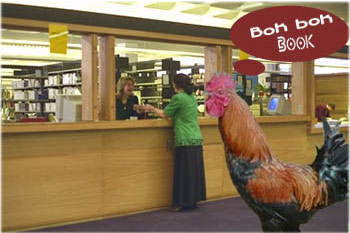 A chicken walks into the library. It goes up to the circulation desk and says: “book, bok, bok, boook”.
The librarian hands the chicken a book. It tucks it under his wing and runs out. A while later, the chicken runs back in, throws the first book into the return bin and goes back to the librarian saying: “book, bok, bok, bok, boook”. Again the librarian gives it a book, and the chicken runs out. The librarian shakes her head.
Within a few minutes, the chicken is back, returns the book and starts all over again: “boook, book, bok bok boook”. The librarian gives him yet a third book, but this time as the chicken is running out the door, she follows it.
The chicken runs down the street, through the park and down to the riverbank. There, sitting on a lily pad is a big, green frog. The chicken holds up the book and shows it to the frog, saying: “Book, bok, bok, boook”. The frog blinks, and croaks: “read-it, read-it, read-it”.
Finch Report on Open Access
Why the UK Should Not Heed the Finch Report (by Steve Harnad - the OA guru)
A report has emerged from the Finch committee
that looks superficially as if it were supporting OA, but is strongly
biased in favour of the interests of the publishing industry over the
interests of UK research. Instead of recommending building on the UK’s
lead in cost-free Green OA, the committee has recommended spending a
great deal of extra money to pay publishers for “Gold” OA publishing. If
the Finch committee were heeded, the UK would lose both its lead in OA
and a great deal of public money — and worldwide OA would be set back at
least a decade.
JISC Academic Database Assessment Tool (ADAT)
This site from JISC Collections aims to help libraries to make informed decisions about future subscriptions to bibliographic and full text databases (Thanks to Anne Moon from UWC for alerting me to this via Twitter!0
At Libraries, Quiet Makes a Comeback
by Jennifer Howard
The buzzing of smartphones, the clacking of computer keys, the chatter of study groups: Academic libraries aren't the quiet temples to scholarship they used to be. Personal portable technology takes some of the blame. So does the current pedagogical emphasis on group work. In response to students' devices and habits, many libraries have installed coffee shops and embraced the learning-commons model of design, creating wired spaces where groups can gather and plug in...
Friday, July 13, 2012

Thursday, July 12, 2012

Study reveals social-media behaviour of young researchers
see report: The study found that 23 per cent of all the students have used an
online forum passively but only 13 per cent have taken an active part in
any discussions. Similarly, 23 per cent followed blogs, but only 9 per
cent maintained a blog themselves. Active take-up of
institutionally-provided open web resources is also low, with students
requesting more information about technologies and applications such as
Google Scholar, cloud computing, EndNote and Mendeley.
The report also found a continuing lack of understanding about the nature of open access. Generation Y students who responded felt that putting their own work out openly would bring them no positive benefits, and may even have a negative impact. Doctoral students also perceived the intellectual property and copyright environment as a source of confusion.
The report also found a continuing lack of understanding about the nature of open access. Generation Y students who responded felt that putting their own work out openly would bring them no positive benefits, and may even have a negative impact. Doctoral students also perceived the intellectual property and copyright environment as a source of confusion.
Subscribe to:
Posts (Atom)