Wednesday, July 18, 2012

5 Things You Can Do on LinkedIn

1. Search for Events
2. Add an Application
3. Customise your news feed with LinkedIn Today
4. Join a Group
5. Experiment with LinkedIn Labs


Tuesday, July 17, 2012

Open Access – What’s a Learned Society To Do?

Following the publication of the UK Finch Group’s report on expanding access to research publications, there has been another flurry of debate about open access (OA).Open Access promomateriaal

The Big Deal, the Medium Deal, and the Tiny Deal

The Big Deal (TV channel) I remember answering a question on the "Big Deal" in last year's CPD assessment. I find The Scholarly Kitchen's blog post insightful.

Great way to join in discussions on Libraries

The Groups option on LinkedIn is useful to find discussion groups on Libraries (and of course, other subjects!).  Once signed into LinkedIn, click on Groups and then search for "libraries" - you can then join a group/s of interest

Monday, July 16, 2012

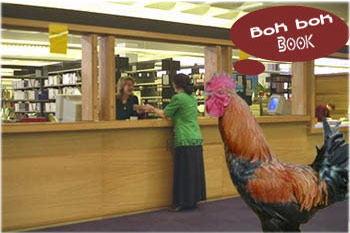
Chickens in Libraries

chickenlib.jpgA chicken walks into the library. It goes up to the circulation desk and says: “book, bok, bok, boook”.
The librarian hands the chicken a book. It tucks it under his wing and runs out. A while later, the chicken runs back in, throws the first book into the return bin and goes back to the librarian saying: “book, bok, bok, bok, boook”. Again the librarian gives it a book, and the chicken runs out. The librarian shakes her head.
Within a few minutes, the chicken is back, returns the book and starts all over again: “boook, book, bok bok boook”. The librarian gives him yet a third book, but this time as the chicken is running out the door, she follows it.
The chicken runs down the street, through the park and down to the riverbank. There, sitting on a lily pad is a big, green frog. The chicken holds up the book and shows it to the frog, saying: “Book, bok, bok, boook”. The frog blinks, and croaks: “read-it, read-it, read-it”.

Finch Report on Open Access

Why the UK Should Not Heed the Finch Report  (by Steve Harnad - the OA guru)
A report has emerged from the Finch committee that looks superficially as if it were supporting OA, but is strongly biased in favour of the interests of the publishing industry over the interests of UK research. Instead of recommending building on the UK’s lead in cost-free Green OA, the committee has recommended spending a great deal of extra money to pay publishers for “Gold” OA publishing. If the Finch committee were heeded, the UK would lose both its lead in OA and a great deal of public money — and worldwide OA would be set back at least a decade.

JISC Academic Database Assessment Tool (ADAT)

This site from JISC Collections aims to help libraries to make informed decisions about future subscriptions to bibliographic and full text databases  (Thanks to Anne Moon from UWC for alerting me to this via Twitter!0

At Libraries, Quiet Makes a Comeback

by Jennifer Howard


The buzzing of smartphones, the clacking of computer keys, the chatter of study groups: Academic libraries aren't the quiet temples to scholarship they used to be. Personal portable technology takes some of the blame. So does the current pedagogical emphasis on group work. In response to students' devices and habits, many libraries have installed coffee shops and embraced the learning-commons model of design, creating wired spaces where groups can gather and plug in...

Why You Need to Learn the Art of Using Hashtags

Why and how to use hashtags. Hashtags are used on social media platforms like Twitter...........

Thursday, July 12, 2012

Free online textbooks


Bookboon.com 


Check out this site


Study reveals social-media behaviour of young researchers

see report: The study found that 23 per cent of all the students have used an online forum passively but only 13 per cent have taken an active part in any discussions. Similarly, 23 per cent followed blogs, but only 9 per cent maintained a blog themselves. Active take-up of institutionally-provided open web resources is also low, with students requesting more information about technologies and applications such as Google Scholar, cloud computing, EndNote and Mendeley.
The report also found a continuing lack of understanding about the nature of open access. Generation Y students who responded felt that putting their own work out openly would bring them no positive benefits, and may even have a negative impact. Doctoral students also perceived the intellectual property and copyright environment as a source of confusion.
As we are librarians and in the business of reading, is it safe to assume that we all do read?

http://mg.co.za/article/2012-07-11-the-reading-nation


DOI® Name Resolver Button

I have just come across this useful tool to resolve DOIs - easy to download to your Toolbar/Links

Wednesday, July 11, 2012

Tuesday, July 10, 2012

100 Time-Saving Search Engines for Serious Scholars

While burying yourself in the stacks at the library is one way to get some serious research done, with today’s technology you can do quite a bit of useful searching before you ever set foot inside a library. Undergraduates and grad students alike will appreciate the usefulness of these search engines that allow them to find books, journal articles and even primary source material for whatever kind of research they’re working on and that return only serious, academic results so time isn’t wasted on unprofessional resources.

Wednesday, July 4, 2012

Saturday, June 30, 2012

Citation Cartel Journals Denied 2011 Impact Factor

Thomson Reuters released the 2011 edition of the Journal Citation Report (JCR) on Thursday, promoting increased coverage of regional journals and listing 526 new journals receiving their first journal impact factor. Far less conspicuous was a list of 51 journals that were suspended from this year’s report due to “anomalous citation patterns.”